一次真实保存的分析:从提问到报告A saved analysis: from question to report
原始问题Original question · translated
分析最近一期经营表现,找出最值得管理层关注的问题和机会,解释原因,并告诉我下一步应该做什么。Analyze the latest business performance, identify the issues and opportunities management should prioritize, explain why, and recommend the next action.
报告发现Finding
门店 429 × COUPON/MISC ITEMS 的销售额减少 $377.29。Store 429 × COUPON/MISC ITEMS: sales decreased by $377.29.
第 52–53 周,对比第 50–51 周Weeks 52–53 versus weeks 50–51
- 本期销售额Current sales
- $524.12
- 对比期销售额Prior sales
- $901.41
- 销售额变化Sales change
- −$377.29
报告建议的下一步Recommended next step
先检查该门店与品类的商品、促销和供给代理指标,再决定是否采取大范围调整。Inspect product, promotion and availability proxies for store 429 within COUPON/MISC ITEMS before applying a broad intervention.
公开数据上的确定性规划与分析;报告建议尚未执行,实际业务效果未评估。Deterministic planning and analysis on public data. Report recommendations were not executed; business impact was not evaluated.
Complete Journey · 1,469,307 条交易明细 · CC0。中文发现与建议为保存结果的翻译,数值按两位小数显示;原始请求和输出可下载核对。Complete Journey · 1,469,307 transaction rows · CC0. The question is translated from Chinese; values are displayed to two decimals. The original request and output are available for inspection.
查看原始报告 PDFOriginal report PDF ↗ 来源执行记录Source run ↗ 请求与结果 JSONRequest and result JSON 原始 HTML 源码Original HTML source 来源与文件哈希Provenance and hashes
保存于Saved on 2026-09-28 · commit 444c545 · retail-602b0bef3a19
查看同次执行保存的界面截图View the browser capture from the same run
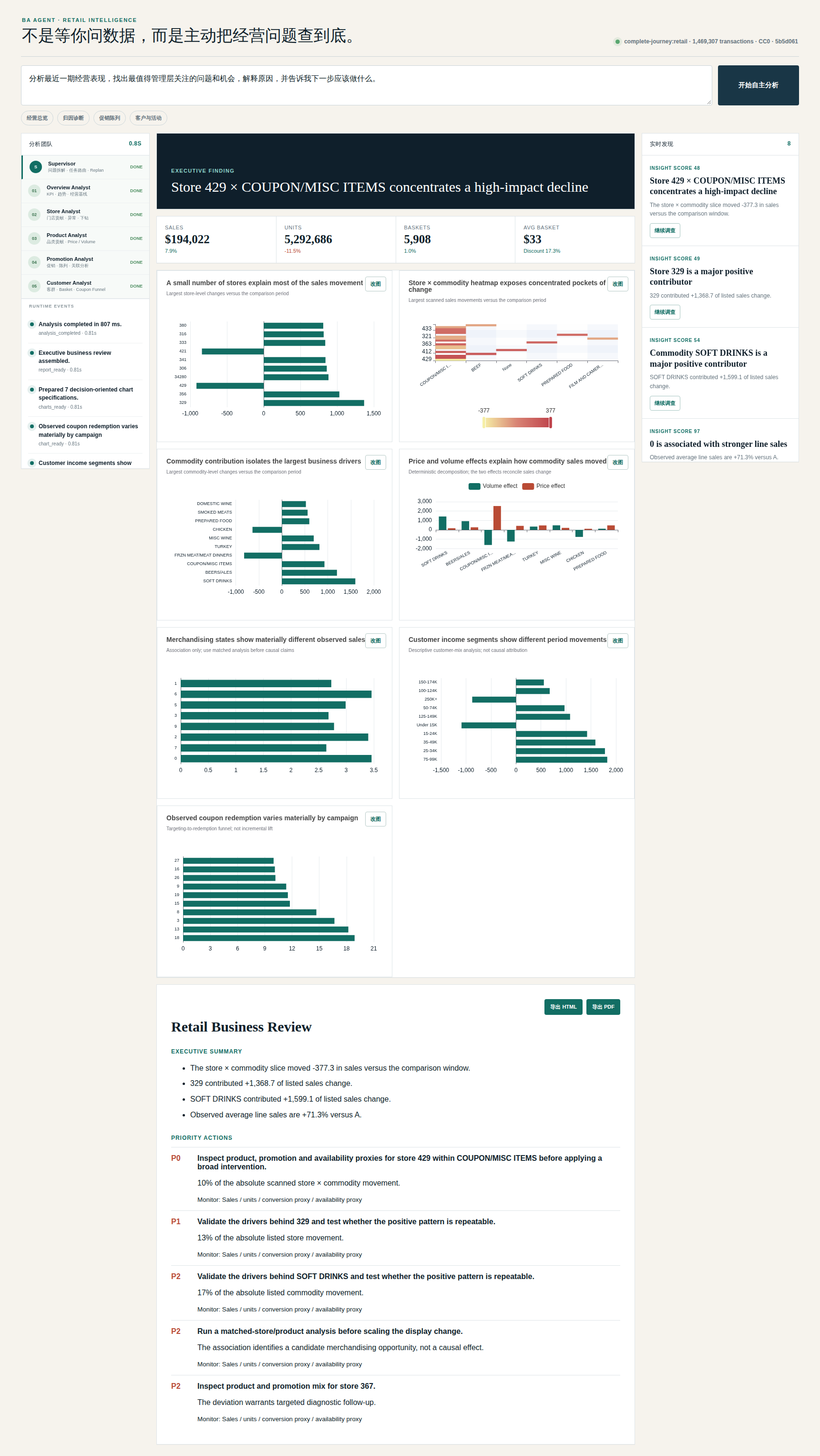
企业经营分析常常需要反复取数、下钻和对齐指标口径。AI BA(Enterprise Data Agent)将一次业务提问推进为完整调查:识别分析目标,安排门店、商品、促销和客群工作流,根据结果继续下钻,最后生成带证据的经营报告。
关键决策:规划与计算各自承担什么
核心取舍是把调查规划与数值计算分开:工作流负责决定看哪些业务维度,确定性算子负责计算,语义层负责口径与访问边界。这使核心结果能够按输入、公式与数据来源复核,也要求新增分析能力扩展相应的语义规则和算子。
先明确业务含义。 语义层把问题解析为指标、维度、时间、实体、约束与意图,集中管理公式、关联关系和业务规则。分析结果携带语义包版本与内容哈希,使同一个指标的定义能够被追溯。语义实现
让调查能够继续。 LangGraph 图串联语义解析、初始规划、并行专家执行和重规划。Supervisor 调度总览、门店、商品、促销和客群五类专家,根据已返回的结构化观察决定是否追加工作流。持久任务状态、检查点和回放接口支持恢复调查;追问通过父任务 ID 沿用分析窗口,再按明确的 focus 继续下钻。调查图 · 应用运行时
让能力有明确边界。 五类专家通过版本化注册表使用 12 个分析 Skill,覆盖贡献分析、异常扫描、价格与销量分解、客群和优惠券漏斗等任务。模型策略只能选择允许的工作流与 Skill,核心查询和计算由受控程序执行;公开评测默认采用确定性策略。Skill 目录 · 版本化运行时
把计算和证据放进同一条链路。 核心分析由确定性算子完成,覆盖贡献分析、价格与销量分解、异常和交叉维度扫描。结果按问题相关性排序,再组织成图表、行动建议和 HTML / PDF 报告。受控 PostgreSQL 连接器限定可访问的表、列和聚合操作,并以只读事务、超时及结果上限约束查询。实现与证据索引
已有结果
零售参考产品使用固定版本的公开 CC0 Complete Journey 数据。下列结果来自仓库保留的内部评测记录,采用可复现的确定性规划路径。数据与评测报告
| 检查内容 | 结果与条件 |
|---|---|
| 数据基础 | 1,469,307 条交易明细、20,940,529 条促销状态、92,331 条商品记录;导入保存来源、哈希和行数 |
| 多窗口分析 | 30 个案例,覆盖 5 个历史窗口;评测以独立只读 SQL 计算数值答案 |
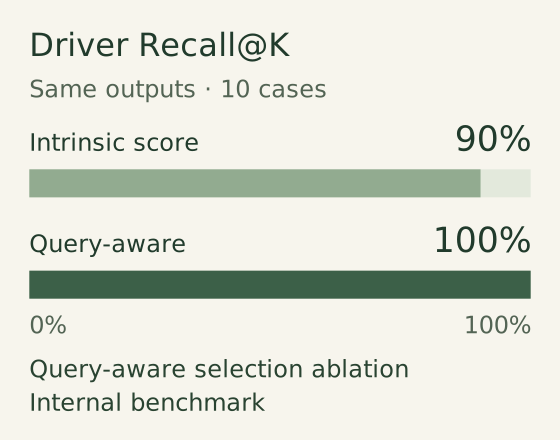
| 问题相关排序 | 同一批分析输出、10 个案例,Driver Recall@K 从 0.90 提高到 1.00,增加 10 个百分点 |
| 动态调查 | 10 个案例中,有 8 个在初轮分析后追加专家工作流 |
| 并行专家执行 | 一次固定 CI 消融中,五类专家平均耗时由串行 461.53 ms 降至并行 330.07 ms,减少约 28.5%(1.40× 加速) |
| 异常与对抗输入 | 14 类场景、210 项任务;开发集通过 164 / 168,独立冻结集通过 42 / 42,合计 206 / 210(98.10%);4 个缺失数据措辞失败仍保留 |
并行耗时采用履历证据表中的固定 CI 消融记录,反映该次运行的墙钟时间,不代表生产吞吐能力。98.10% 是开发集与冻结集两部分的合计,通过率仍分别报告。
这些记录描述了指定工作负载中的行为;同输出消融隔离了查询相关结果选择的贡献。实时模型策略已经有接口,外部模型服务的效果与延迟没有计入以上结果;公开数据中的促销和销售关系按相关性解释。
当前重点
继续完善陌生 PostgreSQL 数据库的语义接入与评测。仓库已有目录探测、受控聚合探查、失败分析和语义补丁升级流程,并记录了盲接入对照实验。模型驱动接入的实际效果仍需运行带凭据的评测后再报告。语义演进实验
Business analysis often requires repeated queries, drill-downs, and agreement on metric definitions. This project turns one question into an investigation: identify the analytical goal, dispatch store, product, promotion, and customer workstreams, follow the findings, and deliver an evidence-linked report.
Key decision: separate planning from calculation
The design separates investigation planning from numerical execution. Workflows choose which business dimensions to inspect; deterministic operators calculate the results; the semantic layer defines meaning and access boundaries. This makes core results traceable to inputs, formulas, and sources, while new analytical capabilities require explicit semantic rules and operators.
Resolve business meaning first. A semantic layer maps each question to metrics, dimensions, time, entities, constraints, and intent. It owns formulas, joins, and business rules. Results carry the semantic package version and content hash so a reported metric can be traced to its definition. Semantic implementation
Keep the investigation moving. A LangGraph loop connects semantic resolution, initial planning, parallel execution, and re-planning. The Supervisor dispatches five specialists for overview, stores, products, promotions, and customers, then uses typed observations to decide whether another analytical wave is needed. Persistent task state, checkpoints, and replay interfaces support recovery; follow-ups retain the parent task’s analysis window and an explicit focus. Investigation graph · Application runtime
Define the capability boundary. The five specialists use 12 analytical Skills through a versioned registry, covering contribution analysis, anomaly scans, price-volume decomposition, customer segments, and coupon funnels. Model policies select only permitted workstreams and Skills; governed programs execute the core queries and calculations. The public benchmark uses the deterministic policy by default. Skill catalog · Versioned runtime
Connect calculations to the final evidence. Deterministic operators perform contribution analysis, price–volume decomposition, anomaly detection, and cross-dimensional scans. Query-aware ranking selects findings for charts, actions, and HTML / PDF reports. A governed PostgreSQL connector restricts tables, columns, and aggregate operations through read-only transactions, timeouts, and bounded results. Implementation and evidence map
Recorded results
The retail reference product uses a pinned public CC0 Complete Journey dataset. These are repository-recorded internal evaluations using a reproducible deterministic planning policy. Data and evaluation report
| Evaluation | Result and scope |
|---|---|
| Data foundation | 1,469,307 transaction rows, 20,940,529 promotion states, and 92,331 product records; ingestion records sources, hashes, and row counts |
| Multiple time windows | 30 cases across 5 historical windows, with numerical gold computed by independent read-only SQL |
| Query-aware ranking | On identical analytical outputs across 10 cases, Driver Recall@K rose from 0.90 to 1.00: +10 percentage points |
| Dynamic investigation | Re-planning added specialist workstreams in 8 of 10 cases |
| Parallel specialist execution | One pinned CI ablation reduced mean five-specialist wall time from 461.53 ms sequentially to 330.07 ms in parallel: approximately 28.5% less time, or 1.40× speedup |
| Adversarial inputs | 210 tasks across 14 families; 164 / 168 development cases and 42 / 42 frozen holdout cases passed, totaling 206 / 210 (98.10%); four missing-data paraphrase failures remain documented |
The parallel timings come from the pinned CI ablation in the résumé evidence map. They describe that run’s wall time, not production throughput. The 98.10% aggregate combines development and frozen partitions; their individual pass rates remain visible.
These results document behavior on the evaluated workload; the same-output ablation isolates the effect of query-aware finding selection. Optional live-model policies have interfaces, but their provider-backed quality and latency are outside these measurements. Associations in the observational retail data are not treated as causal effects.
Current focus
Extend semantic onboarding for previously unseen PostgreSQL databases. The repository includes catalog introspection, bounded aggregate probes, failure mining, semantic patches, and a blind onboarding comparison. Live model-driven onboarding requires a credentialed evaluation before reporting provider-backed gains. Semantic evolution experiment